Tunisia Go
Client
- Self-directed
Project type
- Travel Atlas & Road Trips
What I did
- Next.js 15
- React 19
- TypeScript
- Tailwind CSS
- Leaflet
- Framer Motion
- Supabase
- Offline PWA
- FR / EN
Year
- 2026
Overview
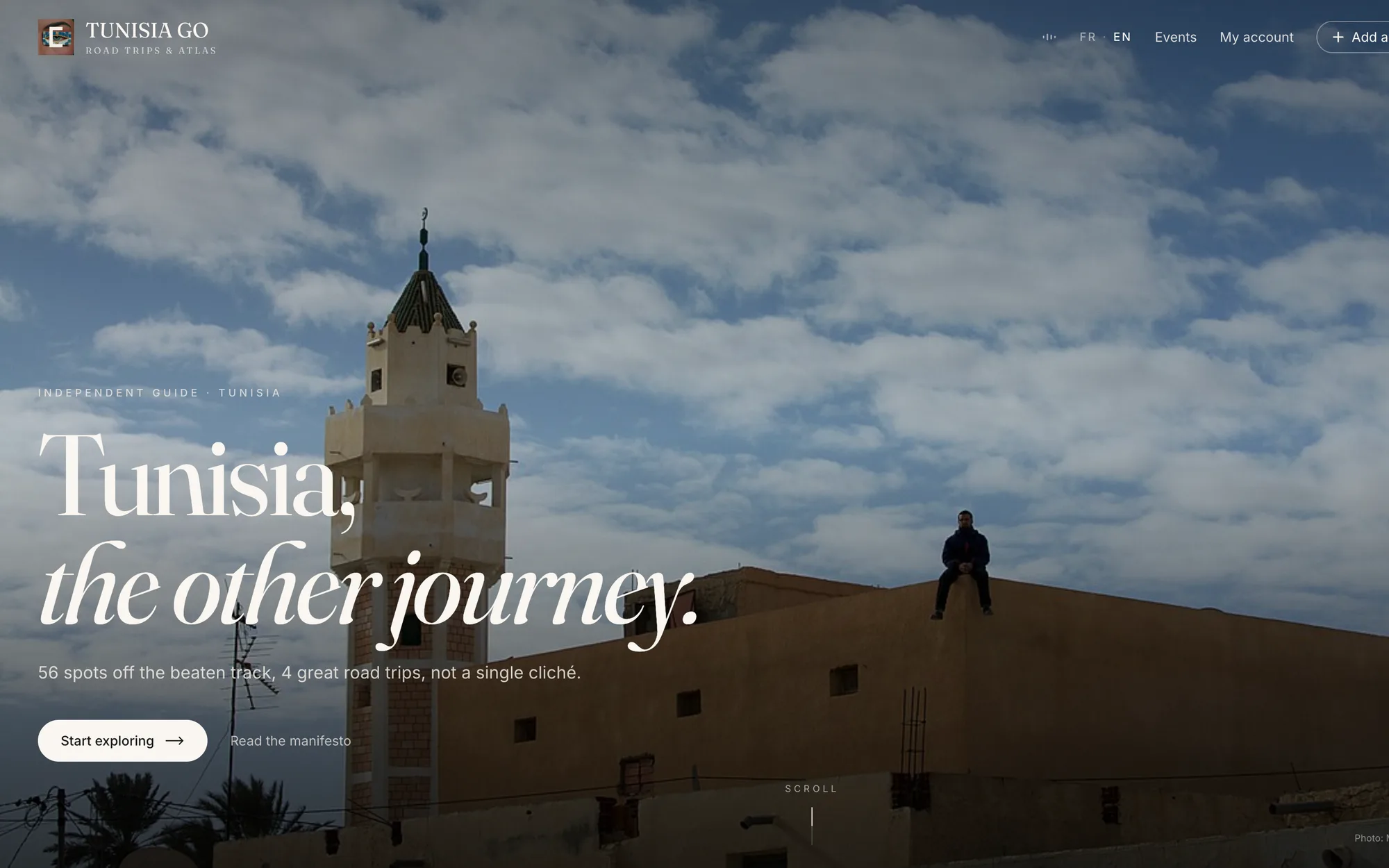
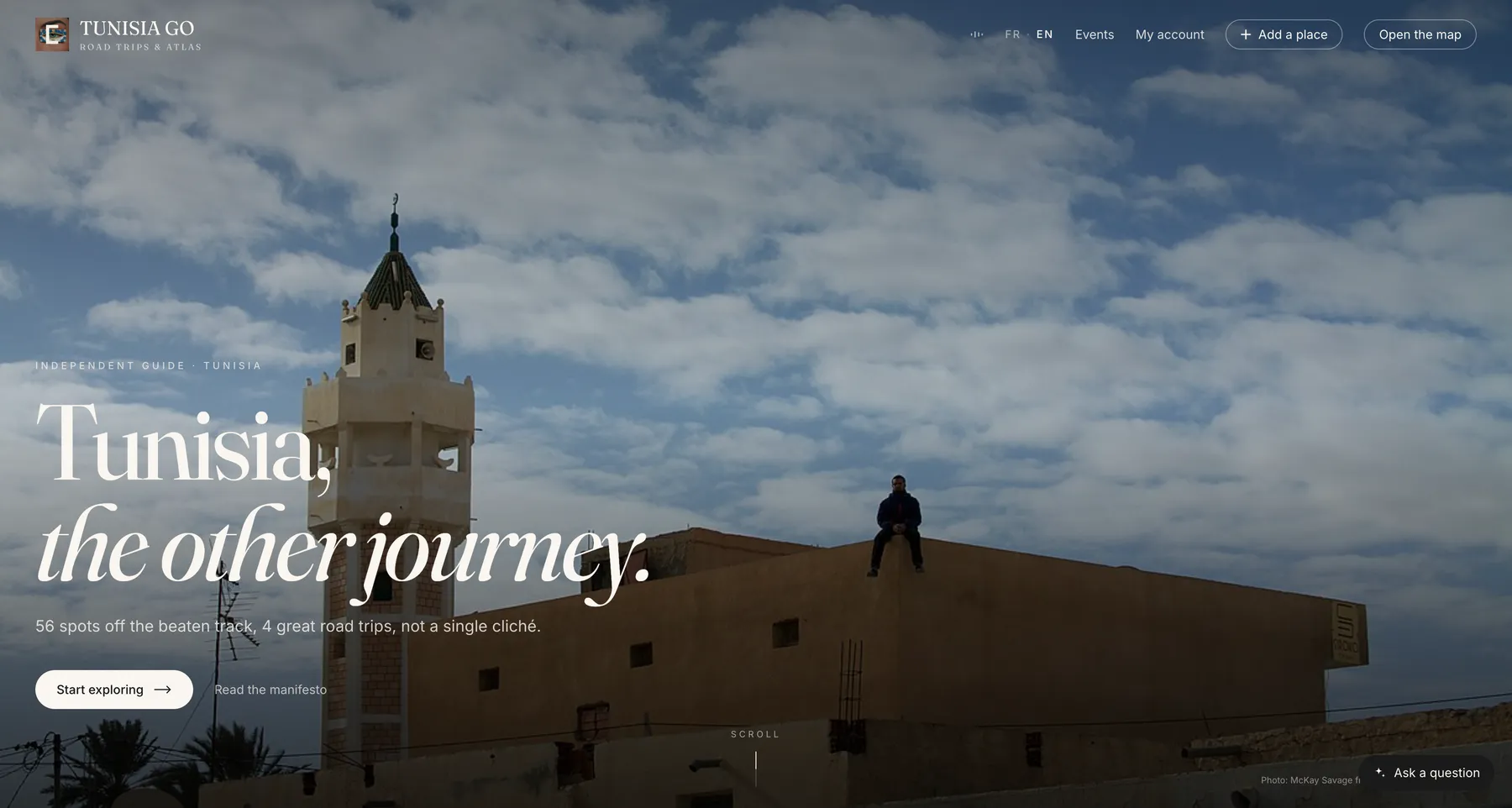
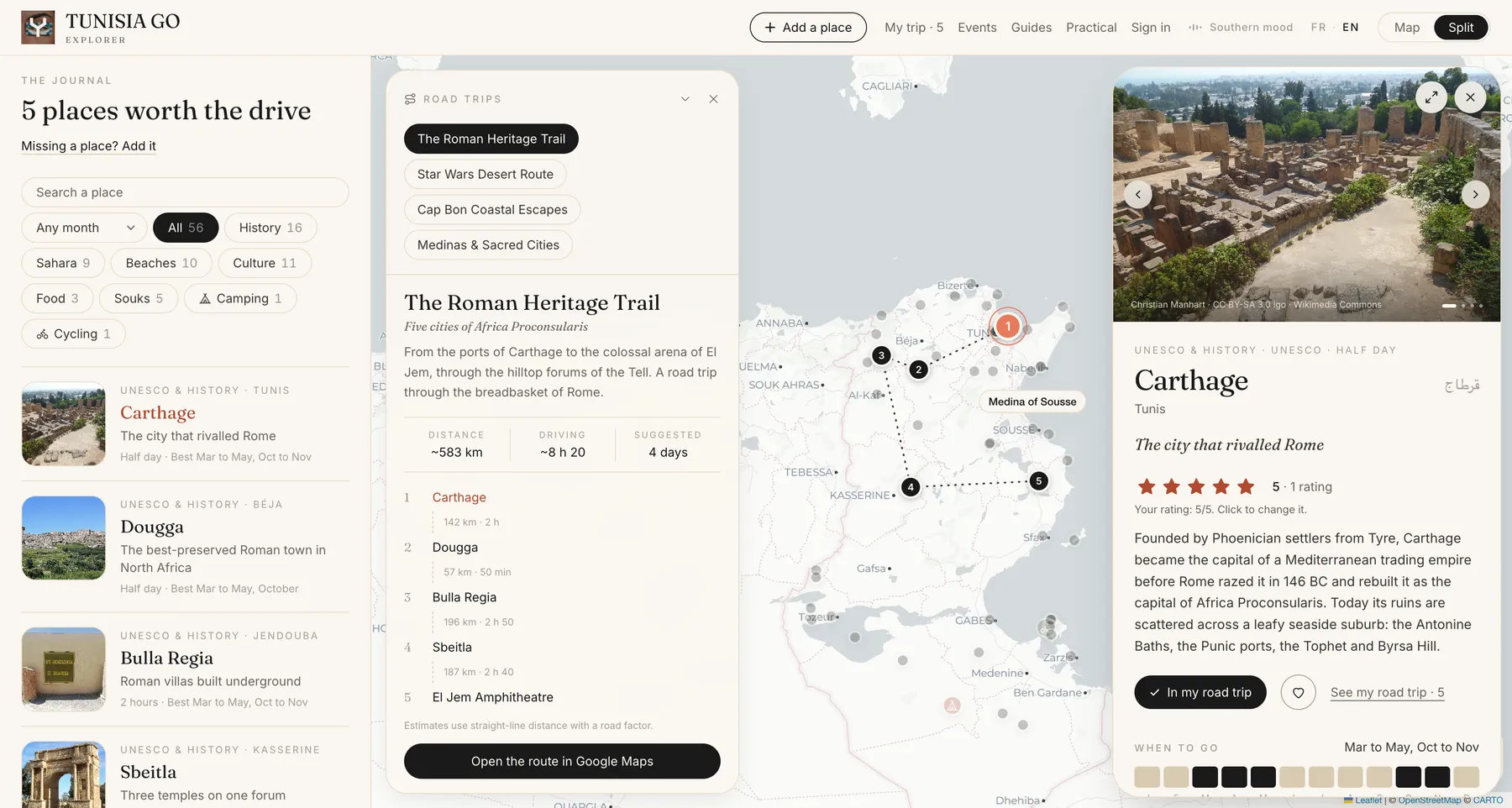
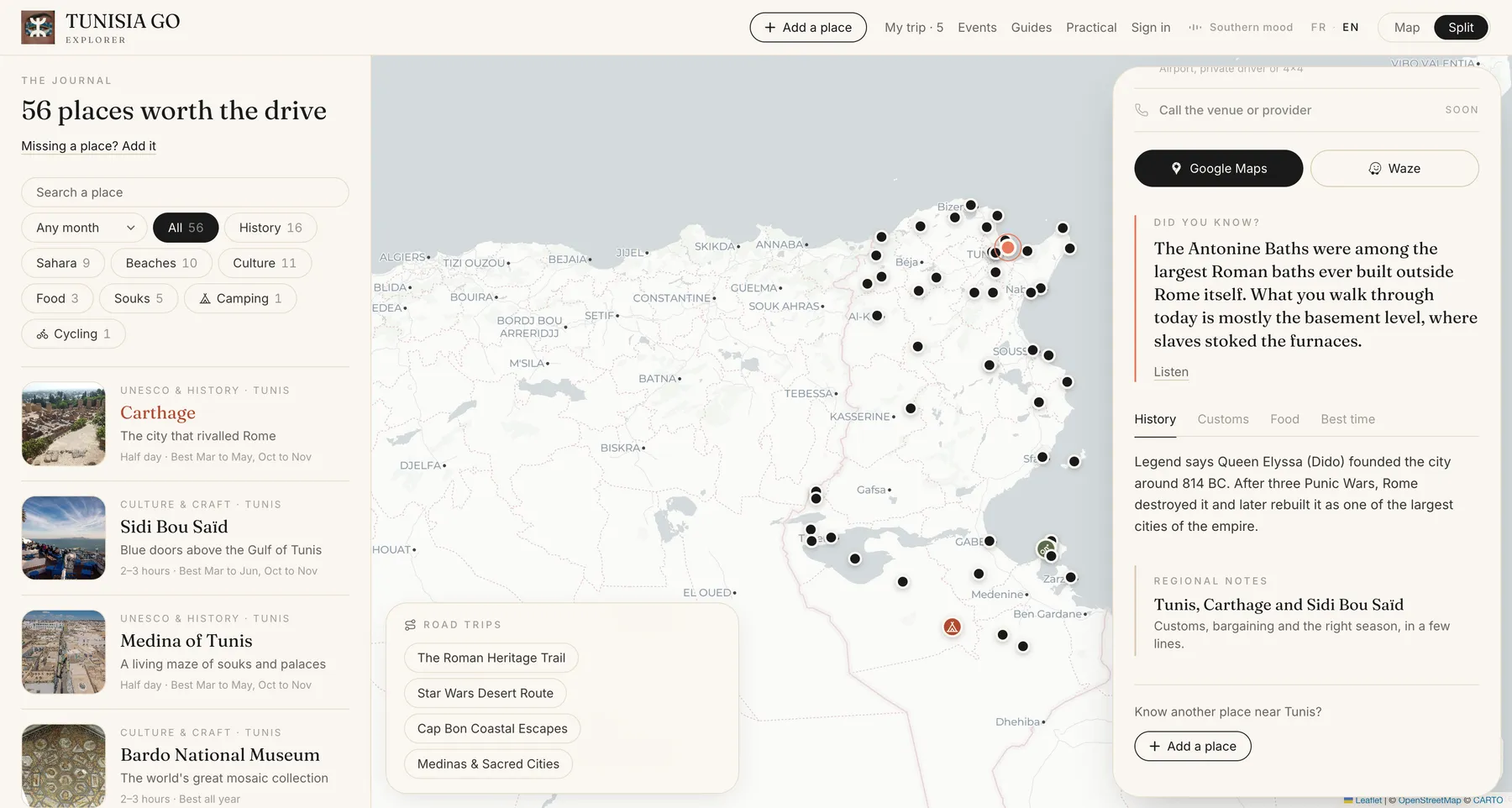
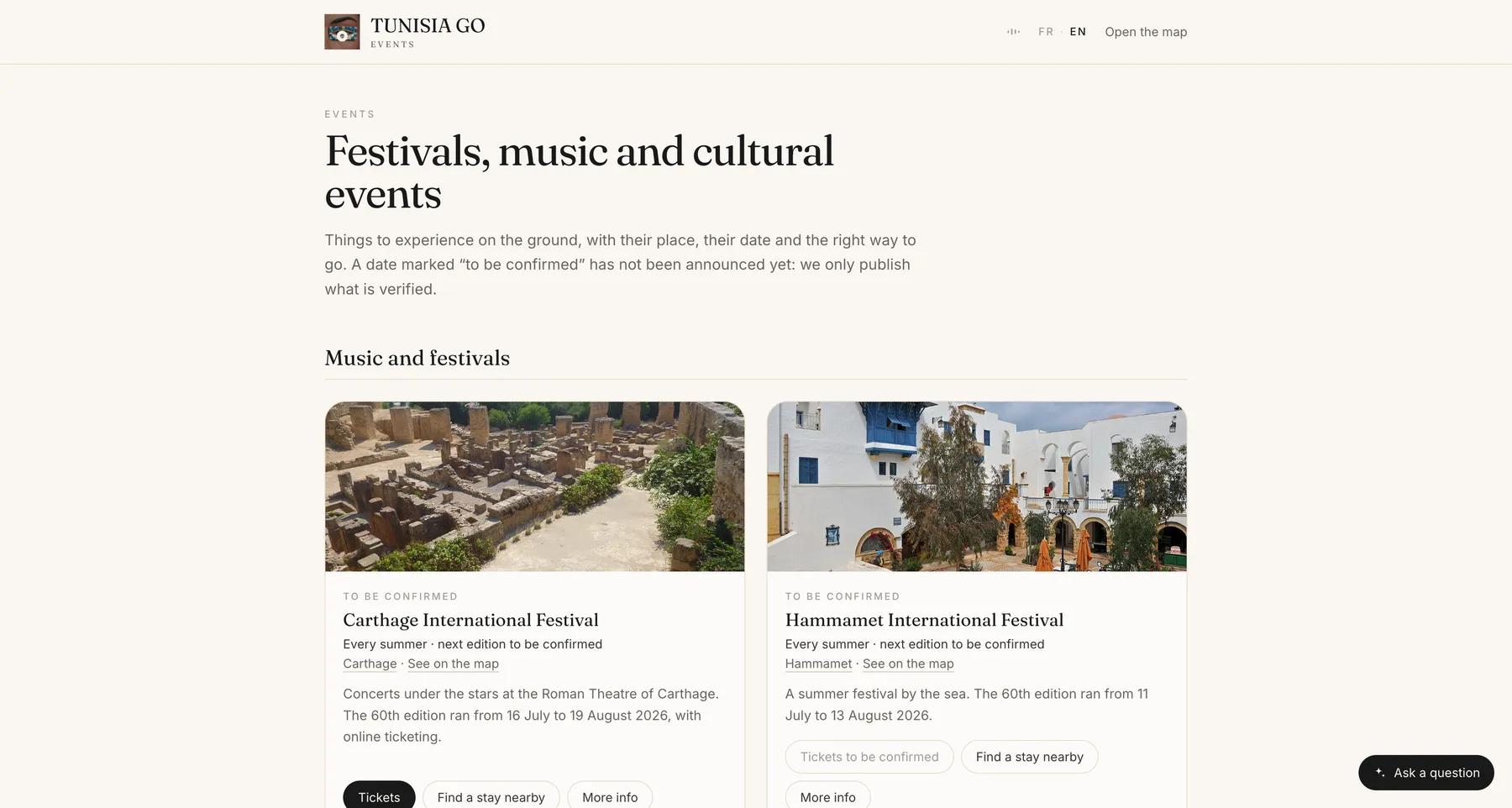
Tunisia Go is an independent guide that treats the country as an atlas rather than a list of hotels. Fifty-six places across eight kinds of journey (heritage, Sahara, beaches, culture, food, souks, camping, cycling) sit on one interactive map, from Sidi Bou Said to the Star Wars set of Mos Espa. Each opens on a sheet with photographs credited from Wikimedia Commons, its story, the best months to go, and every next step: somewhere to sleep, a transfer, a local guide on WhatsApp, Google Maps or Waze. Curated road trips give distances and driving times, Mon voyage lets travellers build their own, share it and export it as a printed booklet, and a whole trip can be saved for offline use where the network drops. Around it sits a community layer: accounts for travellers, guides and agencies, suggested spots and road trips with moderation, ratings and events.
The problem
- 01
Tunisia is sold as a beach package. The mosaics, the ksour, the Sahara and the medinas are scattered across blogs, tour operators and old forums, with nowhere to see the country as a whole.
- 02
Inspiration and logistics live apart: a beautiful photo of a place says nothing about how far it is, when to go, where to sleep or who can take you there.
- 03
Driving the south means long stretches without signal, exactly where a traveller needs the map and the plan.
- 04
Local guides and small agencies, the people who make the trip, are hard to find and harder to reach from abroad.
- 05
Travel content ages fast. A guide written once is wrong a season later unless the people on the ground can correct and enrich it.
The solution
- 01
One map as the front door: every place by category, with filters for the kind of trip and the month, markers that glow on hover, and a Split view that pairs the map with an editorial feed.
- 02
A place sheet that ends in action: a carousel of credited photographs, the story, a Did you know card read aloud, the good and bad months, then Booking, Airbnb, a transfer, a guide on WhatsApp, a call, Google Maps or Waze.
- 03
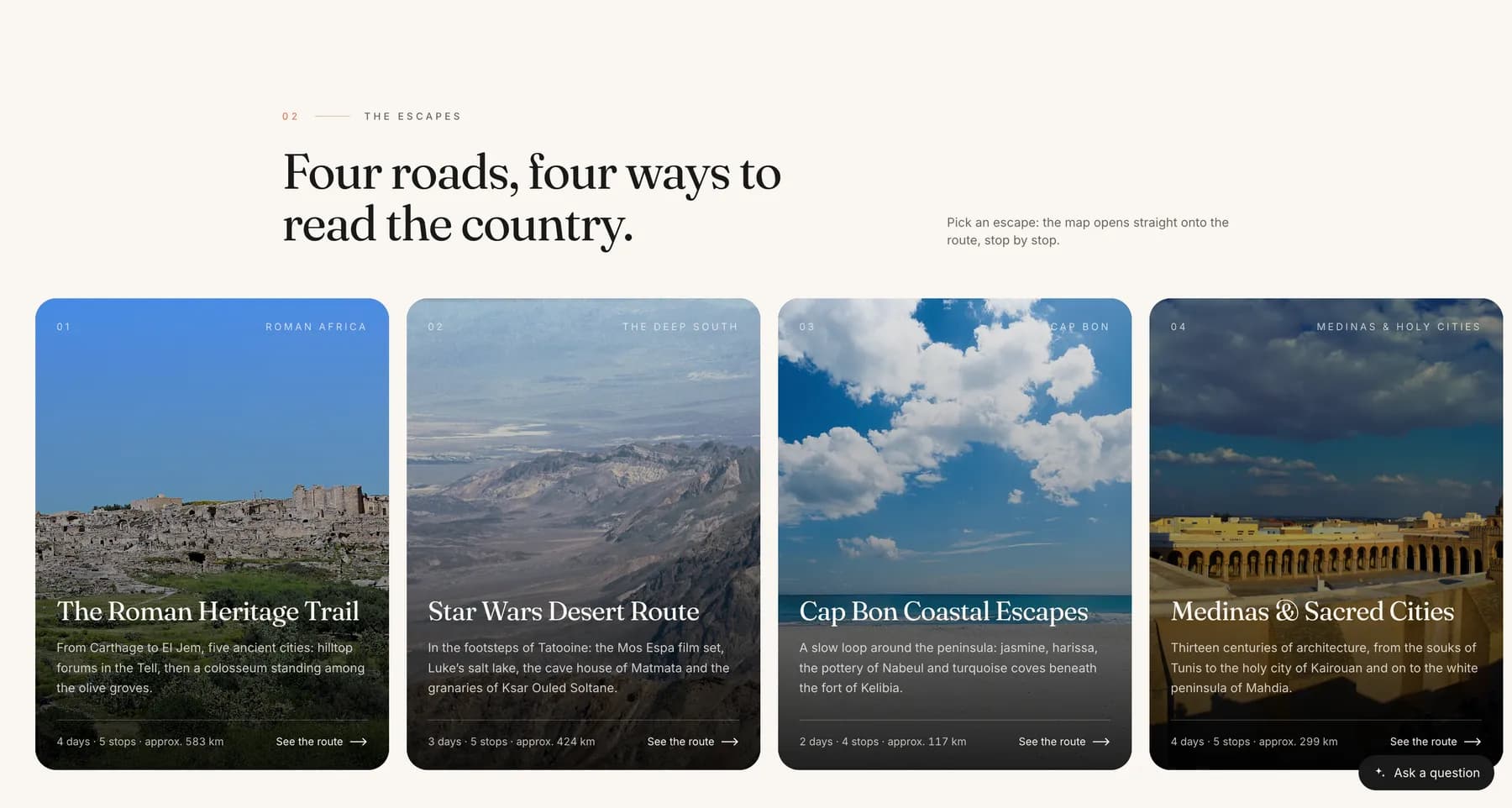
Road trips as first-class objects: four curated circuits drawn on the map with the distance and driving time of every leg, and Mon voyage to build your own, share it by link and export it as a PDF travel booklet.
- 04
Offline by design: the site installs as an app, and a road trip can be saved with the map tiles along its route and the photos of every stop.
- 05
A travel assistant that runs entirely in the browser, with no language model: it reads keywords, typos and plurals included, asks for days, interests, region and month, and answers only with what the guide actually holds.
- 06
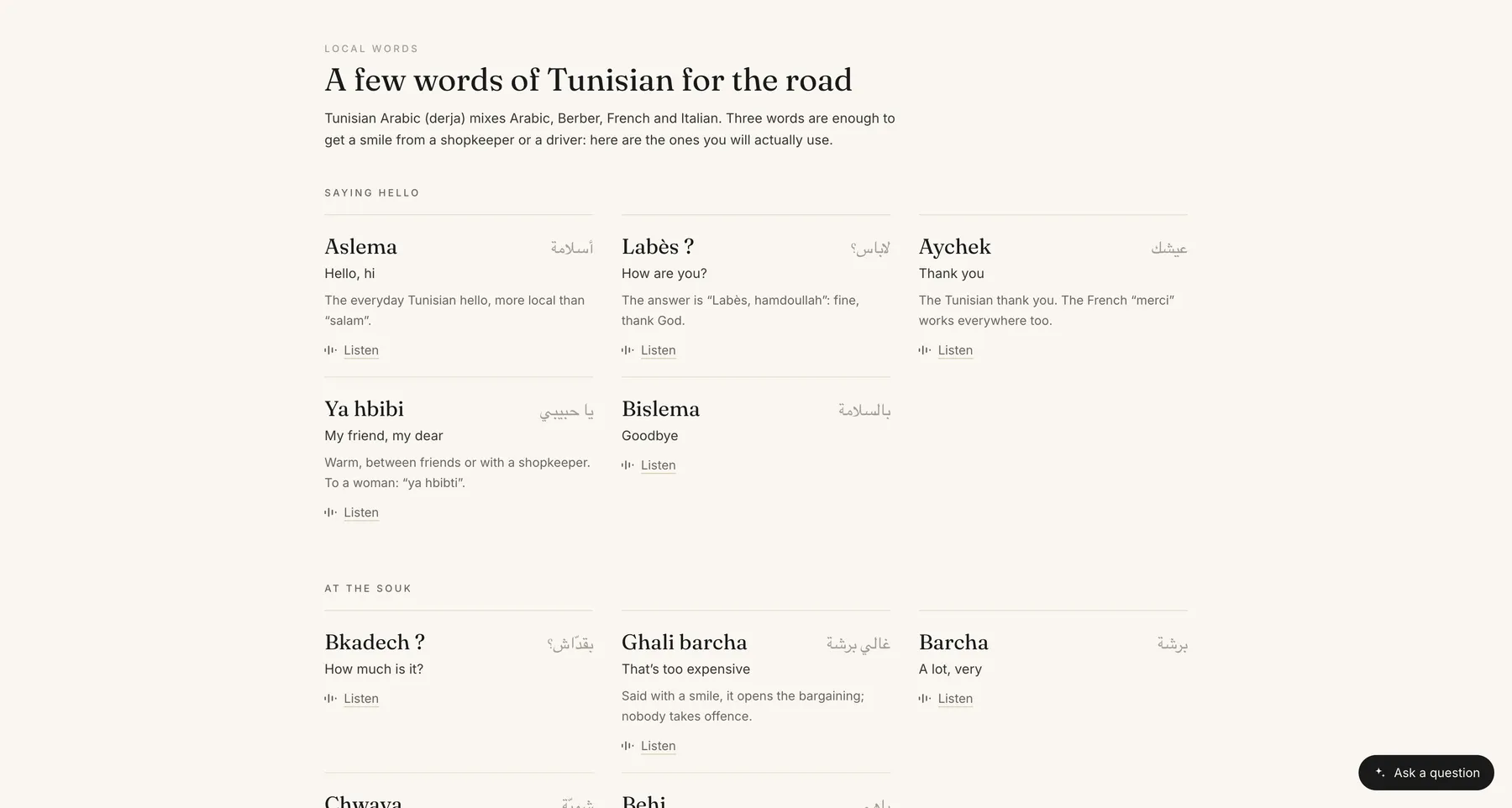
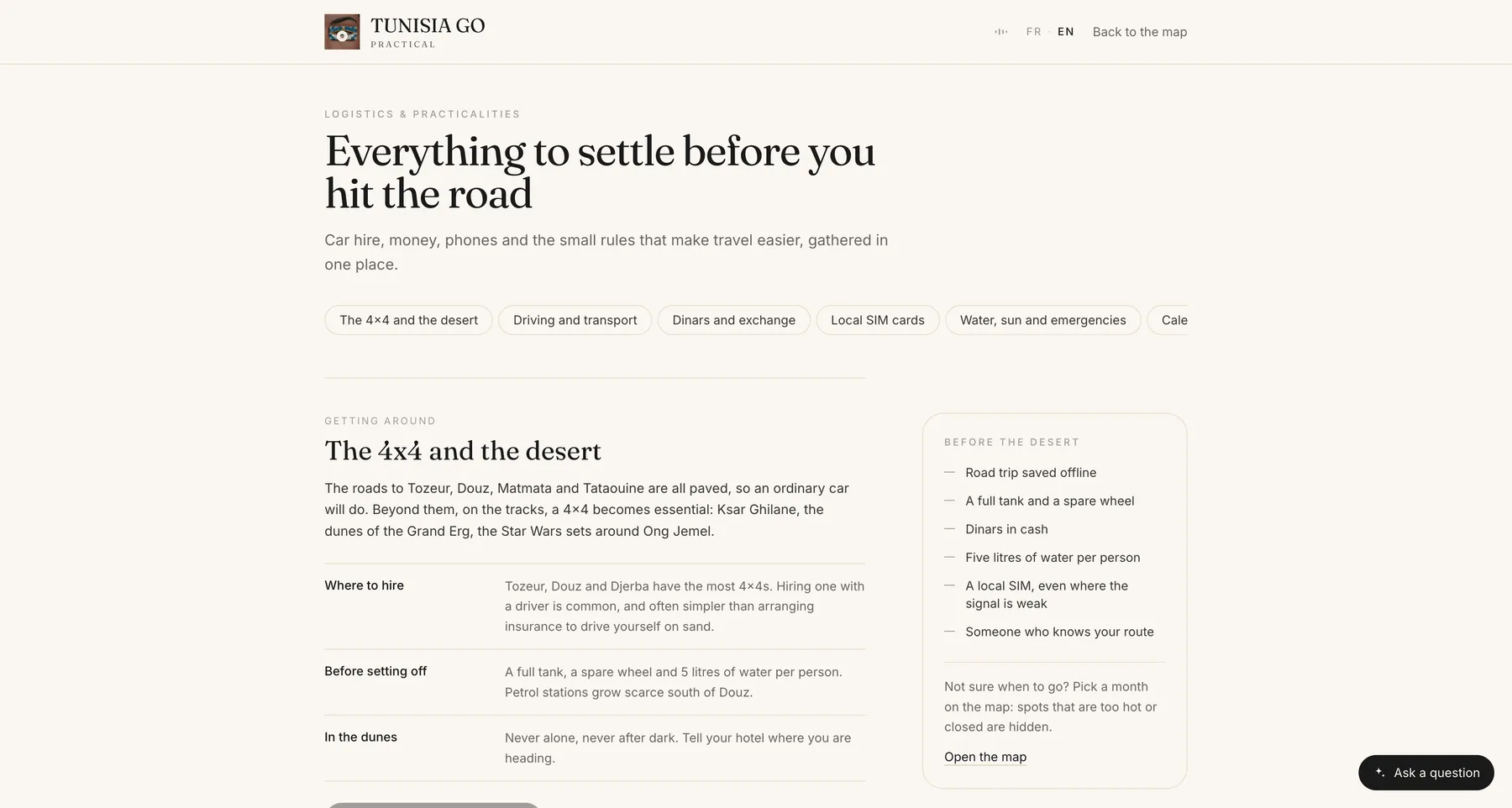
Practical knowledge beside the dream: regional notes on 4x4 rental, driving, money, SIM cards and customs, and Les mots du cru, everyday Tunisian words with their pronunciation to listen to.
- 07
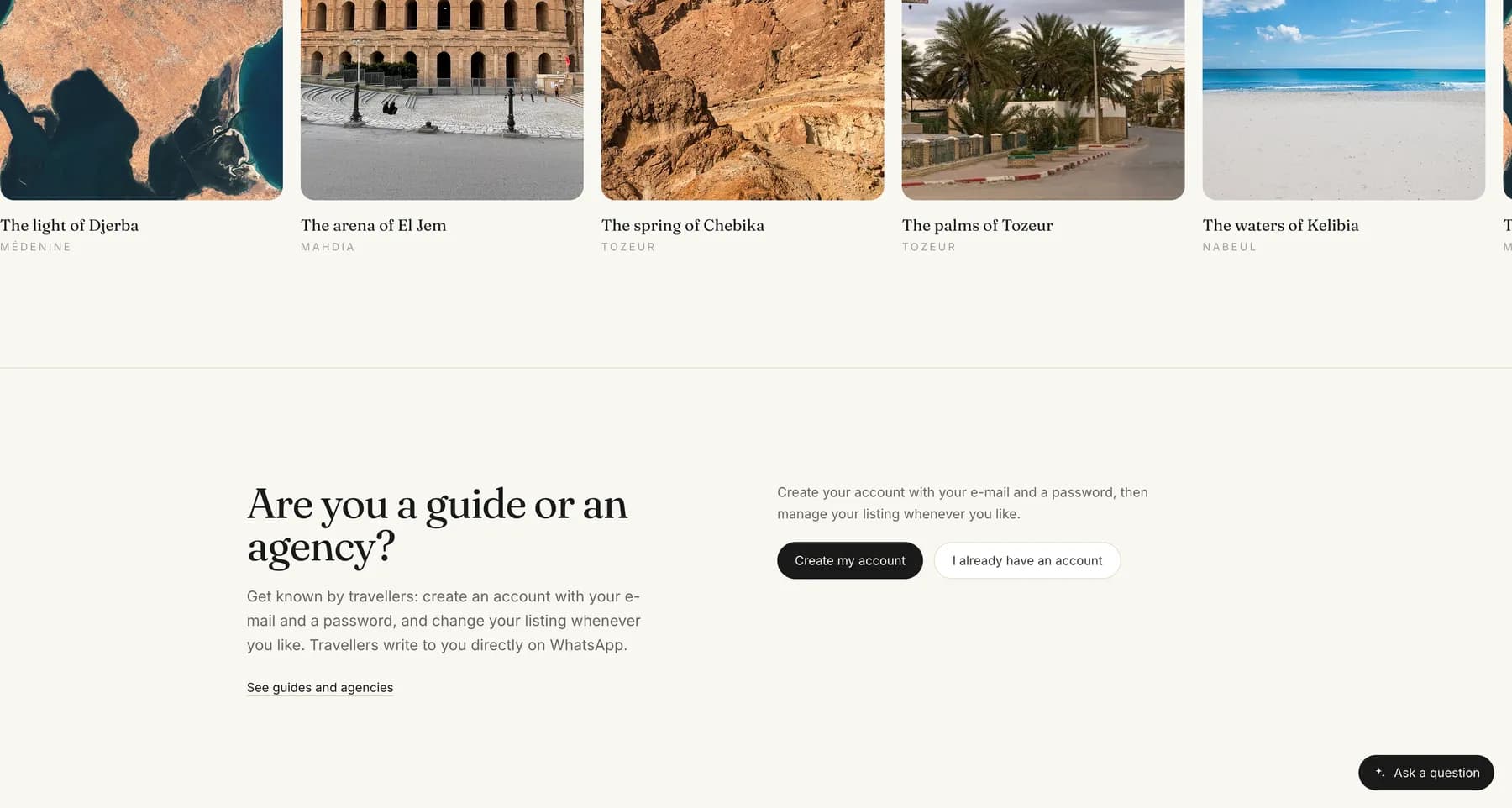
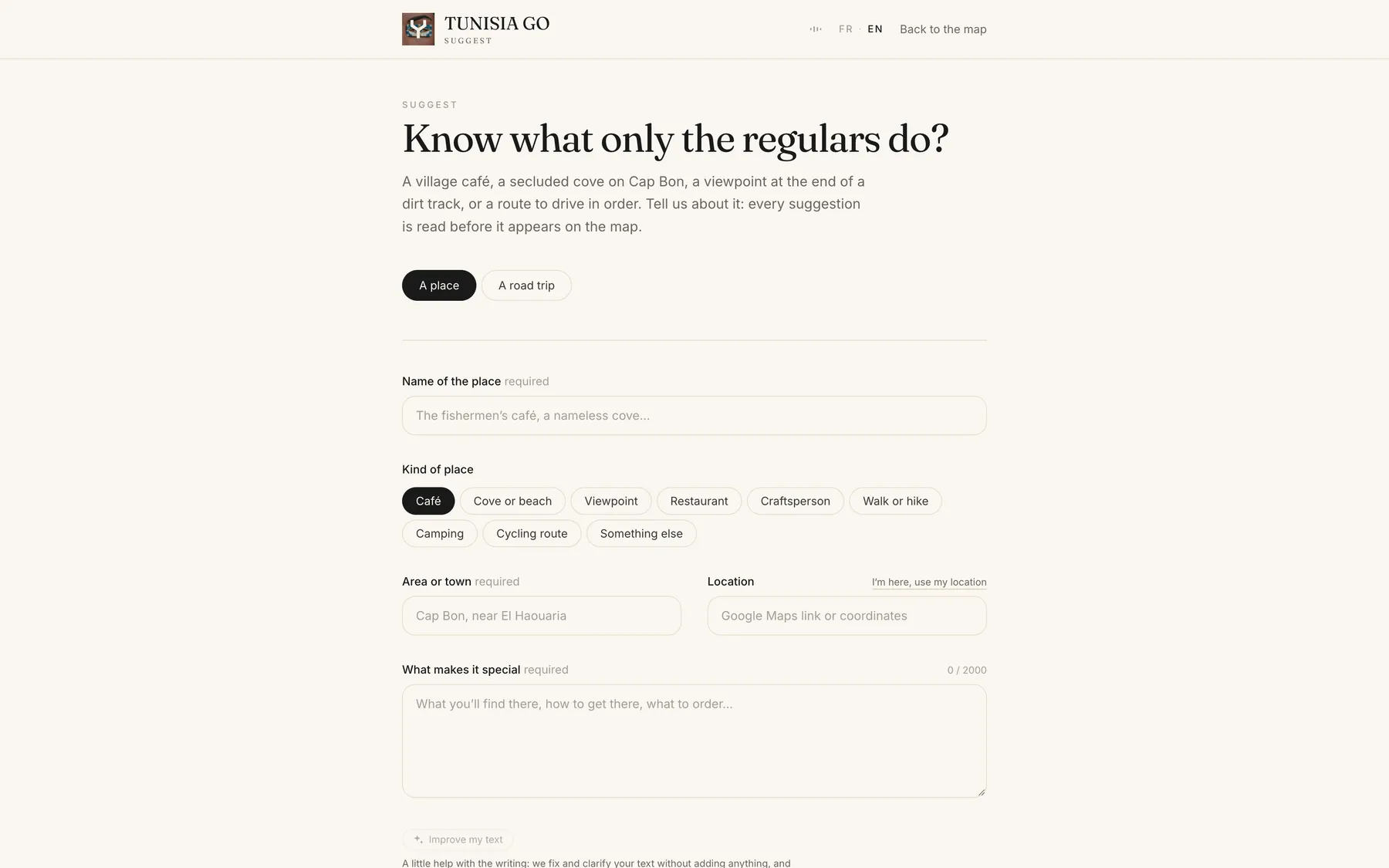
A community with moderation: travellers keep favourites and trips, guides and agencies get profiles with languages, outings and prices, visitors suggest secret spots and road trips with photos, and nothing is published before it passes the admin.
- 08
Bilingual from the routing up: French and English with no prefix in the URL, the language taken from a cookie or the browser, and structured data so search engines understand every place.
In use
Planning a first trip
A visitor filters the map to Sahara and heritage for March, opens Ksar Ghilane, reads when to go, and books a night and a transfer from the same sheet.
Driving the south
Before leaving Tozeur, a couple saves the southern road trip for offline use. Deep in the desert with no signal, the map, the route and the photos are still there.
Building and sharing a trip
In Mon voyage a traveller strings together Matmata, Djerba and El Jem, sends the link to friends, and prints the itinerary as a booklet.
A local guide joins
A guide in Djerba creates a profile with languages, outings and prices, appears on the guides map, and travellers reach them on WhatsApp.
Screens
A sixteen-second vertical reel for social media, built in code like the site itself: the logo, the promise, then the outline of Tunisia drawn line by line and a road trip from Sidi Bou Said to Tozeur, one stop at a time, before the call to open the map. Same Fraunces and Inter, same terracotta, same grain.
Etihad Voyage